Schoters, a subsidiary of Indonesia’s leading EdTech company Ruangguru, operates the Work Abroad program to support global mobility and vocational readiness for Indonesians seeking employment overseas, particularly in Japan and Germany. The program is designed to bridge Indonesia’s demographic potential with growing labor shortages abroad by providing integrated language training, cross-cultural preparation, interview readiness, and job placement support.
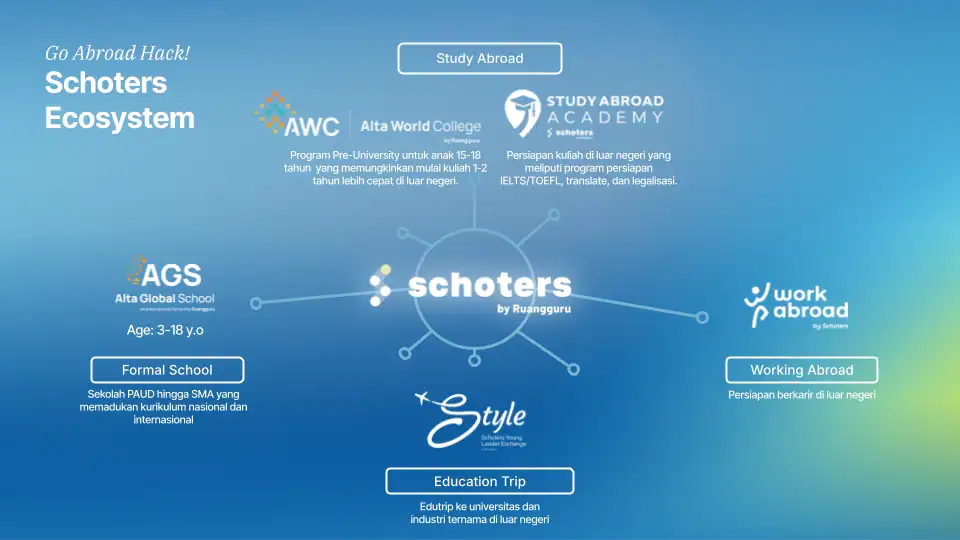
Backed by Ruangguru’s nationwide infrastructure and digital learning ecosystem, Schoters positions itself as a credible, structured pathway for young Indonesians to access international career opportunities, while addressing the systemic barriers that often prevent successful overseas placement.
Challenges
Despite strong demand for overseas employment, the Work Abroad program by Schoters faces a systemic disconnect between Indonesian labor supply and global market requirements. This gap is driven not by a lack of interest, but by a series of structural, behavioral, and operational barriers that limit successful placement.

Language and Competency Barriers
Most applicants fail to meet minimum language and vocational standards required by destination countries, resulting in consistently low acceptance rates during early screening stages.

Cultural Readiness Gap
Limited understanding of workplace norms and living cultures in destination countries creates adjustment risks that employers are unwilling to accommodate.

Trust Deficit and Financial Constraints
High upfront costs, rigid payment structures, and fear of scams discourage commitment and significantly reduce conversion, particularly outside urban centers.

Operational and Scalability Limitations
Dependence on third-party agencies and manual internal processes restrict operational control, scalability, and the clarity of value behind premium pricing.

External Market Pressures
Regulatory volatility, illegal broker competition, and limited penetration beyond urban Java constrain growth in high-demand regional markets.
Changes Analysis
The challenges faced by the Work Abroad program are shaped not only by internal limitations, but also by shifts in the external environment in which Schoters operates. Regulatory oversight, labor-market dynamics, social expectations, and technological adoption are simultaneously expanding overseas employment opportunities while raising the standards required for credible and scalable placement.
| Political • G2G programs expand formal placement channels. • BP2MI oversight tightens compliance standards. • Policy support remains execution-heavy. |
| Economic • Domestic unemployment increases outbound labor supply. • Wage gaps drive strong overseas interest. • High entry costs limit participation. |
| Social • G2G programs expand formal placement channels. • BP2MI oversight tightens compliance standards. • Policy support remains execution-heavy. |
| Technological • EdTech enables scalable preparation. • Flexible learning reduces access barriers. • Demand for skilled labor rises globally. |
| Environmental • Limited direct impact on placement. • Disruptions affect training continuity. |
| Legal • Visa rules are non-negotiable. • Certification defines eligibility. • Documentation gaps halt placement. |
Taken together, these changes reshape how candidates evaluate risk, credibility, and return on investment when considering overseas employment. Understanding these behavioral responses is critical, making customer analysis the next logical step in assessing Schoters’ strategic position.
Customer Analysis
Insights from the customer research indicate that participation in the Work Abroad program is shaped less by aspiration and more by risk assessment, credibility, and expected return on investment. Although interest in overseas employment is widespread, commitment occurs primarily when candidates perceive the pathway as structured, reliable, and outcome-oriented. Consequently, decision-making is influenced more by process transparency, institutional trust, and verified placement outcomes than by promotional messaging.
Schoter’s market can be segmented into four key psychographic personas:
| 55% | Value-Maximizers • Prioritize ROI, credibility, and career certainty. • Respond strongly to structured processes and outcome visibility. • Define the program’s dominant decision logic across regions. |
| 29% | Explorers • Motivated by curiosity and international exposure. • Require guidance to offset uncertainty. • Convert best when flexibility is paired with structure. |
| 11% | Achievers • Career-driven and goal-oriented. • View overseas work as a long-term career accelerator. • Respond to advancement-focused narratives. |
| 5% | Security-Seekers • Highly risk-averse and cautious. • Demand guarantees and institutional backing. • Unlikely to commit without strong trust mechanisms. |
Across regions, Value-Maximizers dominate, reinforcing the importance of ROI-focused positioning. However, risk aversion is higher outside Java, where lower exposure to overseas employment programs increases reliance on trust-building mechanisms such as verified alumni outcomes and clear process visibility.
Competitor Analysis
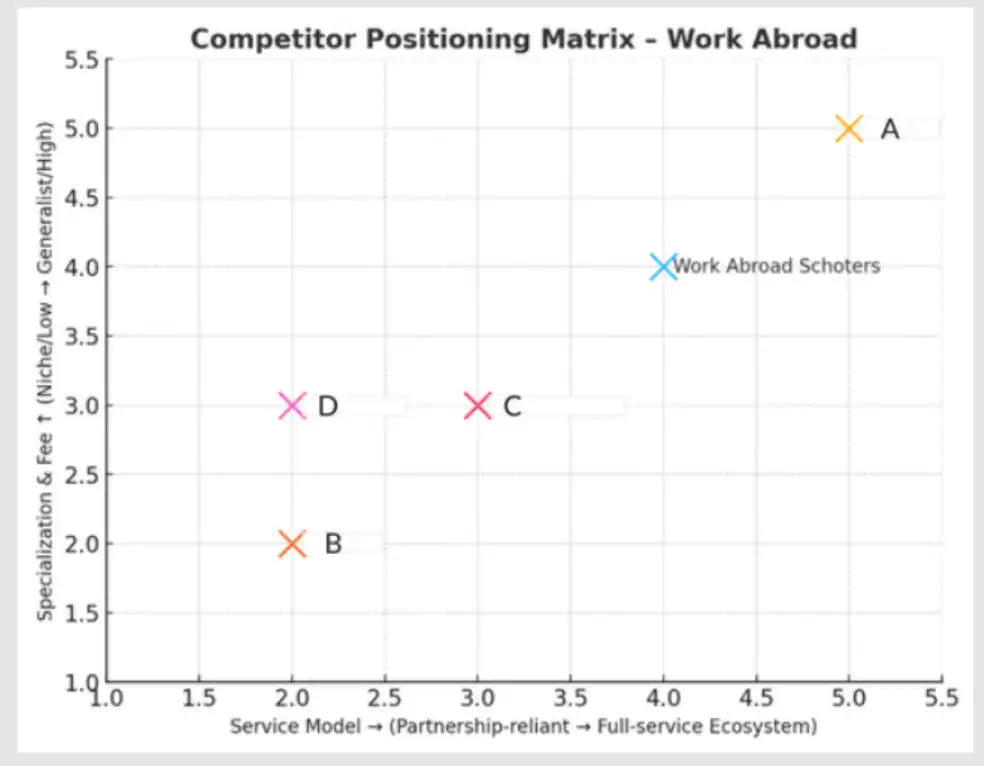
The Competitor Positioning Matrix shows that the Work Abroad market is differentiated by service integration and specialization. Schoters occupies a mid-to-upper position, supported by Ruangguru’s brand credibility and a nationwide network of 80 branches. However, reliance on third-party placement agencies limits operational control and placement scale, weakening differentiation against more integrated competitors. Although G2G programs and global labor demand present growth opportunities, Schoters’ broad, Java-centric targeting and weak ROI-based proof constrain its premium positioning.
STP Analysis
The effectiveness of Schoters’ growth strategy is closely tied to how clearly it segments, targets, and positions its Work Abroad program. While the current STP approach establishes baseline credibility and accessibility, the analysis reveals gaps that limit differentiation and conversion efficiency in an increasingly competitive and trust-sensitive market.
Table below summarizes the current STP practices and the strategic gaps identified.
| STP Element | Current Analysis | Gap Identified |
| Segmentation | Focused on young Indonesians (18-27), mainly first-time migrants in urban Java withmoderate income and strong brand trust inRuangguru. Segmentation is largelydemographic and geographic. | Psychographic, behavioral, and readiness-based segmentation is not yetfully leveraged to differentiate messaging and offerings. |
| Targeting | Broad niche targeting across all work-abroaddestinations with similar program structuresand pricing schemes. Installments used toattract price-sensitive learners. | Lack of persona-specific or destination-specific targeting results in diluted value propositions and limited conversion optimization. |
| Positioning | Positioned as a credible and structuredwork-abroad preparation program underRuangguru, emphasizing holistic preparationand payment flexibility. | Positioning lacks sharp differentiation due to limited alumni outcome proof and weak ROI-based storytelling compared to P3MI and informal bootcamps. |
Overall, Schoters’ STP strategy remains broad and largely demographic, limiting targeting precision and weakening differentiation. The lack of psychographic segmentation and outcome-based positioning reduces the clarity of its value proposition. These gaps indicate the need for a more focused STP approach, which informs the strategic recommendations in the following section.
Recommendation
Kaigo Career Navigator is proposed as an integrated digital platform that structures and visualizes the entire work-abroad journey, enabling candidates to clearly understand where they are, what comes next, and what outcomes to expect.
How the Solution Works
| 1. Entry Point Hero Section: “Track Your Journey to Japan”A clear call-to-action that initiates onboarding and positions the program as a guided, trackable process rather than a one-time enrollment. |
| 2. Trust Formation Alumni StoriesVideo testimonials supported by short credibility quotes to reduce perceived risk and reinforce outcome reliability. |
| 3. Process Transparency Career Progress TrackerReal-time updates on:- Language training progress- Visa and administrative readiness- Job matching and placement statusThis feature transforms preparation into a visible, measurable journey. |
| 4. Financial Clarity Payment Plans ModuleTransparent cost estimation and installment options, including incentives for SMK Keperawatan and equivalent graduates, to lower entry barriers. |
| 5. Offline Integration Job Fair InformationCentralized access to regional job fair schedules and locations, connecting digital preparation with offline recruitment activities. |
Expected Outcome
By embedding trust signals and process visibility directly into the user experience, Kaigo Career Navigator operationalizes the recommended strategy and supports higher conversion and engagement across priority regions.
Conclusion
This case reveals a systemic gap between Indonesia’s labor supply and global demand, shaped by language barriers, skill mismatches, fragmented processes, and trust concerns. Although interest in overseas work is high, participation depends largely on perceived risk, transparency, and return on investment.
While Schoters possesses strong brand credibility, growth is constrained by diluted targeting and limited outcome-based differentiation, particularly outside Java. The proposed Kaigo Career Navigator addresses these constraints by embedding trust, process visibility, and structured guidance into the work-abroad journey, supporting more effective conversion and sustainable market expansion.
Contributors
This is a Business Immersion article researched and written by Group 4 of the Entrepreneurial Marketing MBA (ENMARK MBA) Batch 3, consisting of:
Business Immersion is a key component of the Entrepreneurial Marketing MBA (ENMARK MBA) program, offering students the opportunity to collaborate with industry through group consultancy projects. During the third semester, from September to January, students will work as a team of consultants, tackling real-world business challenges. This immersive learning experience bridges the gap between academic theory and practical application, equipping students with the skills to address complex issues and explore innovative management approaches within established organizations.
—
Entrepreneurial Marketing MBA (ENMARK MBA), a collaboration between MarkPlus Institute and School of Business and Management Institut Teknologi Bandung, is designed to equip future leaders with expertise in marketing, management, business strategy, and an entrepreneurial mindset to drive innovation and career growth.
What sets ENMARK MBA apart is its holistic approach, integrating marketing, finance, and strategy to blend creativity with analytical thinking. Through real-world case studies and hands-on projects, students develop the agility and strategic acumen to excel in today’s dynamic business landscape.